.svg)
.svg)
.svg)
.svg)
.svg)
.svg)



In fast-paced, asset-heavy industries – from large-scale retail and fast-moving consumer goods (FMCG) to corporate enterprises and publishing houses – the volume of digital content produced daily is staggering. Images, campaign materials, localized assets, and social media deliverables constantly flood the content pipeline.
A common misconception is that a DAM system will fix these content problems on its own or that users will adopt the system automatically. Implementing a DAM is never just a technology project. Instead, it is a comprehensive change initiative that touches people, processes, and technology across the entire organization. If you focus solely on the software, you risk low adoption rates. Technology enables DAM, but people sustain it. Ultimately, long-term success depends on strategic alignment, planning, continuity, clarity, control, and ownership.
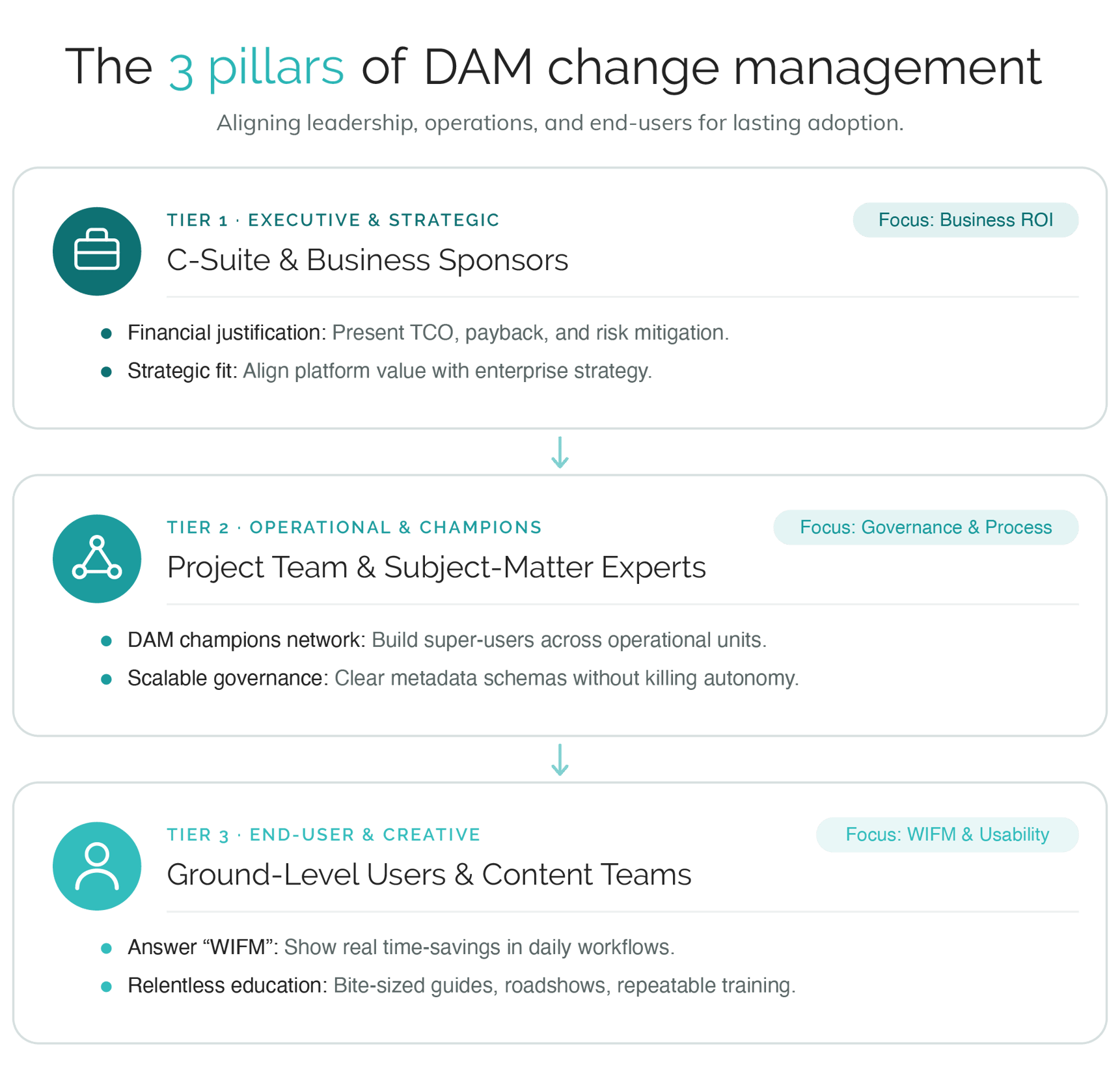
Navigating alignment in enterprise DAM change management
When driving digital asset management adoption across a mid-to-large enterprise, getting everyone on the same page is your first and largest obstacle. You cannot simply drop a new system onto a team, business unit, or group of users and expect overnight efficiency.
Before proposing solutions or selecting a vendor, you must thoroughly understand the current state of your organization. It is crucial to map out your business structures, identify who the users will be, and analyze how they currently work. Conducting interviews with future users allows you to contrast their current pain points with the desired future state. Dig deep into their daily realities, isolate the specific workflows in which digital assets are created or managed, and identify potential automation opportunities. Furthermore, you must understand how and where decisions are made in your organization, identify the key decision-makers, and determine what motivates them.
Building a bulletproof business case for your DAM investment requires data on the current state, not just intuition. Assessing the overall business impact is essential. You must estimate the time currently spent on searching for and processing assets, and compare it with the estimated time savings from the new solution. Only by laying this groundwork can you build a solid foundation for your enterprise DAM strategy.

Assembling the ideal team for DAM change management success
A fundamental rule of change management is that you cannot implement a DAM on your own. To succeed, you must secure a dedicated project team that can support you through the different stages of the digital asset lifecycle. This dream team should include a business sponsor to facilitate decision-making, IT experts to enable and ensure technical fit, and a subject-matter expert to support metadata modeling and implementation.
However, simply putting together a core project team isn't enough; you need the ground-level users to buy into the vision. Motivated teams adapt to change much more smoothly than teams that don't understand the purpose and the benefits of that change. Driving this motivation requires answering the ‘What's in it for me?’ question for every stakeholder group. When all of them understand the direct value of the DAM system to their specific daily routines, they will be much more eager to adopt it.
During your current state analysis, identify the most business-oriented individuals and harness their enthusiasm. Use their energy to create a ‘DAM Champions’ community so they can act as ambassadors and motivators in their own departments. Involve these champions in different parts of the project and allow them to take ownership. By training them thoroughly in the importance of metadata, governance, and standard processes, they can act as super-users and be the first point of contact when colleagues need support.

Breaking down operational silos
One of the most common mistakes organizations make is treating the implementation of a DAM system as a one-off technical project. A DAM platform is not a one-time implementation project; digital asset management is an ongoing strategic capability that must be owned, measured, communicated, maintained, and continuously evolved – along with the platform that executes it.
To break down operational silos and ease adoption, we must actively showcase the value and daily perks of the system to our teams from day one. Successful initiatives invest heavily in change management, training, communication, and adoption. This requires shifting the organizational mindset to view the DAM as a central operational backbone that delivers real value, rather than a siloed or mandatory repository.
One critical part of this mindset shift involves scalable DAM governance. Governance is not about restriction – it is about maintaining brand, legal, and operational integrity, while enabling user autonomy. When integrated correctly, your DAM becomes the single source of truth for content flowing across the organization. It connects content creation workflows, marketing operations, and publishing channels into one cohesive content orchestration ecosystem.

Smarter communication strategies for training your users
If you build it, they will not automatically come. You have to sell it. To ease adoption, organize an internal roadshow to spark curiosity. Brand the DAM and create internal hype; effective internal marketing both informs and creates curiosity among future users. Visit different teams and demonstrate the DAM concept, always keeping your varied audience and the ‘What's in it for me?’ question in mind. Once you have their attention, the real work of education begins.
One important topic that should be trained alongside basic platform navigation is metadata. Metadata is the language of discoverability. Users will often view metadata entry as a chore unless they understand its true value. You must teach them that effective metadata enables accurate search instead of endless browsing, filtering instead of scrolling, and that everyone can trust the files they find.
Your training strategy must be relentless. Communicate and train whenever possible, as there will always be team members encountering your message for the first time. Arrange multiple, repeated, possibly recorded, training events for users at different technical levels. Furthermore, provide high-quality, easy-to-read user guides and short instructional videos to ensure help is always accessible. Let your DAM Champions assist with communication and involve them in the training sessions, because they know their teams best.

Proving business value to executive leadership
While user adoption is critical, sustaining an enterprise DAM capability requires ongoing executive support, buy-in, and budget. Leadership requires a different kind of communication. Executives want to know the business case for the investment, what operational challenges are being solved, and what additional opportunities the DAM system enables.
You cannot speak to the C-suite about file formats and tagging rules; you need to frame everything around commercial impact. Leadership wants to understand how a DAM implementation supports or accelerates the company's overarching commercial strategy or future vision.
Make sure that your business case is solid and data-driven. A financial plan must outline the complete financial impacts, including the total cost of ownership (TCO) and the projected payback timeline. You should also present the expected return on investment (ROI) and clear metrics on the specific operational bottlenecks that the DAM will solve for your organization.
Strategic do's and don'ts for enterprise DAM change management
Technology will continue to evolve and scale, and AI will undoubtedly reshape how we use DAM or tag and deliver assets in the future. Yet, the human element remains the deciding factor in whether an implementation succeeds or quietly becomes a legacy IT expense.
To keep your DAM initiative on track, keep the following core principles in mind:
| THE DO'S | |
| Map the current state first | Dig deep into daily realities, processes, and automation points before pitching a technical solution. |
| Build your dream team | Secure an executive sponsor, IT experts, and a subject-matter expert early on. |
| Empower DAM Champions | Find enthusiastic users to take ownership, act as ground-level motivators, and support their peers. |
| Sell the ‘Why’ | Always address the ‘What's in it for me?’ question, and promote the DAM internally with a roadshow to build momentum. |
| Train relentlessly | Teach metadata as the language of discoverability, and host repeatable training events. |
| Speak business to the C-suite | Justify the investment with data-driven metrics like TCO, ROI, and strategic alignment. |
| THE DON'TS | |
| Don't treat it as just a tech project | Digital asset management is an ongoing strategic capability, not a one-off software deployment. |
| Don't expect automatic adoption | If you build it, they won't just come. You have to actively ‘sell’ the system to your users. |
| Don't mistake governance for restriction | Scalable governance should enable user autonomy and maintain brand integrity, not just lock things down. |
| Don't bore leadership with IT jargon | Skip the technical file specs or tagging rules when speaking to executives; talk business strategy |