.svg)
.svg)
.svg)
.svg)
.svg)
.svg)



The hype cycle is over. In its place: a more honest, more complicated picture of AI adoption; one defined not by the tools organizations are using, but by the foundations they have (or haven't) built to use them well.
The 2026 State of AI in DAM & Content Operations report, authored by independent content operations specialist and consultant Kristina Huddart and supported by WoodWing and other industry leaders, draws on insights from 271 professionals across brands, technology vendors, and implementation partners. Scroll down to discover the eight findings that matter most.
1. Nearly 4 in 5 organizations are actively using AI, but only half call it a success
AI adoption has surged. In 2024, 52% of organizations were experimenting with AI. By 2025, 54% had moved into early adoption. Today, 79% are actively using AI within their business.
But there's a gap. Self-reported AI success sits at just 54%, and organizational readiness scores only 3 out of 5. Individual enthusiasm is high, and people rate their personal appetite for AI at 7.25 out of 10 on average, but the infrastructure to match it isn't up to par.
This is the tension defining AI in 2026: widespread adoption without widespread success.
2. How far along you are determines how well it works
The research reveals a stark 42 percentage-point gap in success rates between organizations at different stages of AI maturity:
- Organizations still experimenting with AI: 35% success rate
- Organizations with AI fully embedded: 77% success rate
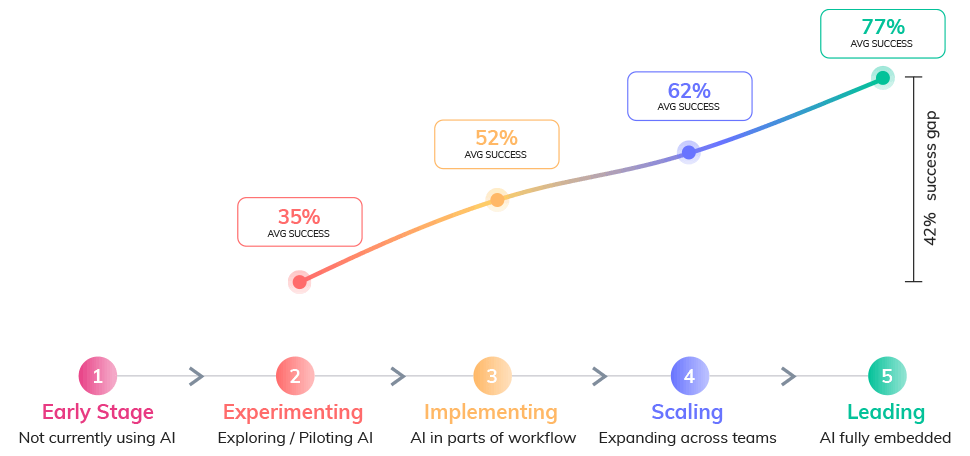
The implication is significant. Hesitating in AI adoption isn't neutral – it's directly correlated with lower performance and fewer realized benefits. The organizations pulling ahead aren't doing fundamentally different things. They've simply committed earlier and with more discipline.
3. Metadata tagging and workflow automation are the most adopted AI use cases
When it comes to where AI is actually being applied, the data shows a clear pattern: adoption concentrates where organizational foundations already exist.
The top AI use cases in 2026 are:
- Metadata tagging & enrichment: 65%
- Workflow / process automation: 63%
- Search & discovery: 58%
- Content creation & production: 57%
More advanced use cases, such as governance and compliance (35%), intelligent content delivery (27%), trail significantly behind. Not because the technology isn't available, but because the data quality, governance structures, and integrated systems they require aren't yet in place. As the report puts it: the ceiling is not the technology – it is the internal structure that enables it.

4. AI is winning in the back office, and the front office is next
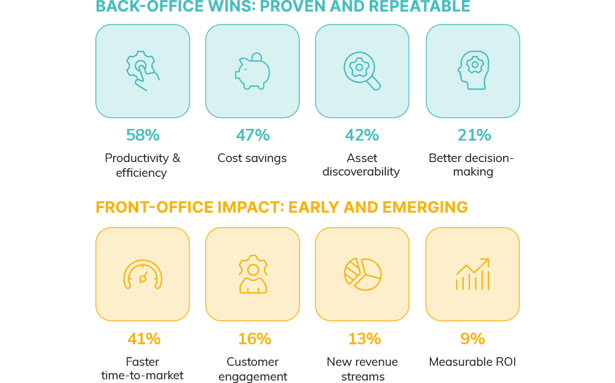
What is AI actually delivering today? The honest picture is one of proven operational gains, with commercial impact still emerging.
Proven back-office benefits:
- Productivity & efficiency gains: 58%
- Cost savings: 47%
- Improved asset discoverability: 42%
- Faster time-to-market: 41%
Still emerging front-office impact:
- Customer engagement: 16%
- New revenue streams: 13%
- Measurable ROI: 9%
Notably, 17% of organizations report no measurable impact from AI at all. Operational efficiency is achievable today. Demonstrable business value is the next frontier, but it requires stronger foundations to get there.
5. Trust is the missing ingredient, and it shows up in three ways
The top barriers to AI success in 2026 aren't separate problems. They're all expressions of a single underlying issue: organizations haven't yet built the trust infrastructure that AI requires to perform.
The trust gap shows up across three dimensions:
- Process trust – Who owns decisions? What are the guardrails?
- Data trust – Can AI outputs be relied on if the underlying metadata can't?
- People trust – Do teams have the skills, mandate, and change management support to use AI effectively?
The top reported barriers reflect this: lack of governance or oversight (83%), metadata and data quality issues (66%), limited AI skills (56%), and unclear ROI or business case (46%). Strikingly, 1 in 4 organizations still has no clear owner for AI initiatives; a structural gap that limits progress regardless of which tools are deployed.
6. Strategy is the single most actionable lever for success
Industry, organization size, and headcount don't reliably predict AI success. Having a formal AI strategy does more than any other factor within an organization's direct control.
Yet the current picture is sobering: only 26% of organizations have a formal AI strategy in place. Half are developing one. A quarter have none at all.
Organizations with a formal strategy are approximately 2.5x more likely to have AI champion networks, 2x more likely to invest in training and upskilling, and 4x more likely to be actively hiring for AI-specific roles. Strategy doesn't just set direction – it drives the people investment and governance discipline that compound over time.
7. How you measure AI shapes how much value you get from it
Most organizations are measuring AI through operational metrics – time saved, content volume produced, campaigns completed. These are easy to track but hard to connect to business value.
The research reveals a direct link between measurement rigor and success rates:
| Measurement approach | Average success rate |
| Financial metrics (ROI, cost, revenue) | 66% |
| Formal KPIs | 64% |
| Operational metrics (time saved, volume) | 52% |
| Anecdotal / qualitative feedback | 48% |
| Not measuring at all | 40% |
Only 1 in 4 organizations currently measure AI using financial metrics – yet those that do, achieve the strongest outcomes. Measurement turns activity into accountability. Without it, value remains assumed rather than proven.
8. The next wave is agentic AI, but most aren't ready for it
The report frames AI evolution in three waves: faster and cheaper (efficiency), better (improvement), and fundamentally different (transformation). Currently, 38% of respondents are in Wave 1, 42% are in Wave 2, and just 11% are operating in Wave 3 – the territory of new business models and AI-first thinking.
The next shift is agentic AI: systems that execute complex, multi-step workflows across entire content stacks. Many vendors are already building toward this. But organizations positioned to take advantage will need strong foundations across all four dimensions: people, process, data, and technology.
The risk of staying in Wave 1 isn't stagnation – it's commoditization. Optimizing purely for speed and cost removes the creativity, judgment, and craft that differentiate great content.
What to do with all of this
The organizations succeeding with AI in 2026 aren't doing different things. They're doing the same things, but with more discipline. They've assigned ownership, invested in AI governance, cleaned their metadata, upskilled their people, and measured outcomes rigorously.
Wherever your organization sits on this maturity curve, the research offers a clear set of next actions: from auditing metadata quality and running 90-day pilots with formal KPIs, through to redesigning workflows around what AI makes possible, not just retro-fitting existing ones.

Want the full picture?
The complete 2026 State of AI in DAM & Content Operations Research report, including all data, segmentation by organization type, and the full action framework, is available for free download from Huddart Consulting's website.
Download the 2026 State of AI in DAM & Content Operations Reseearch report
WoodWing is a proud supporter of this independent research, which is authored and conducted by Kristina Huddart, Content Operations Specialist and Consultant at Huddart Consulting.