.svg)
.svg)
.svg)
.svg)
.svg)
.svg)



Incomplete audit trails, uncertainty about the current version of a document, or access rights that lag behind internal job changes; oversight reports from various years and organizations strikingly often show the same patterns. This is not a matter of unwillingness or a lack of commitment. In fact, compliance and IT teams often work tirelessly to fill every gap and ensure that information flows within their organizations run smoothly. However, the problem keeps recurring because organisations treat the symptoms rather than addressing the underlying cause.
Why ad-hoc process improvements are no longer enough
The traditional way of resolving audit findings in practice is straightforward but inefficient. If the regulator discovers a gap in the documentation surrounding a specific fund flow, a new control process is immediately set up, including the necessary training for the team. By the next inspection, that specific flow is neatly in order, but the regulator promptly encounters a similar problem with a new fund or another department. As long as critical documents are distributed via email, shared network drives, and separate investor portals, every new workflow remains a potential compliance risk.

This legacy approach works fine as long as the document landscape is compact and manageable. But for a growing asset management firm with hundreds of employees, various funds, and dozens of external stakeholders, this method is unsustainable. New document flows simply emerge faster than a compliance department can set up manual control processes. The direct costs of these constant remediation processes and external consultants are already significant, but the indirect damage weighs even heavier. Senior specialists lose valuable time dealing with recurring issues, which places permanent strain on organizational capacity and attracts regulatory scrutiny. Moreover, an organisation that reports the same audit findings year after year builds up a risk profile with the regulator, which can ultimately lead to increased oversight.
The power of built-in quality control at document level
Asset managers who have successfully broken this cycle choose a fundamentally different approach: they embed compliance requirements directly into their digital infrastructure. By opting for robust information governance, control is not embedded in isolated, manual procedures, but in the document layer itself. Every document, every revision, and every change in access rights is recorded fully automatically and irrefutably by the platform. Not because an employee has to remember to do so, but because the system simply does not allow for any other option.
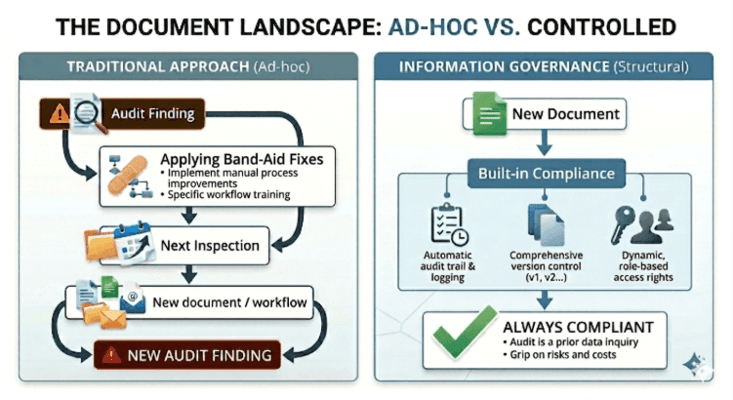
This transition completely changes the nature of an external audit. Instead of a stressful retrospective reconstruction – where teams must frantically figure out who approved which document at what time – the audit becomes a matter of retrieving data in advance. The complete set of documents, including comprehensive audit trails and historical versions, is ready within minutes. The focus thus permanently shifts from the question of whether the data can be reconstructed at all, to what exactly the regulator wants to see. This is not an abstract marketing promise, but the immediate reality when document management inherently meets the strict auditability requirements of the AIFM Directive.
Time for control and a future-proof foundation
The reality is that regulatory pressure from agencies such as the FCA and PRA will only increase in the coming years. Regulators have significantly expanded their digital toolkit and are scrutinizing operations more quickly, deeply, and frequently than before. What was an acceptable workflow a decade ago – e.g., an email confirmation with a physical printout in a binder – simply no longer suffices today.

For asset managers who continue to patch the gaps in their recovery policies with temporary process changes, the tipping point is approaching where recovery time will outpace operational capacity. Continuously applying band-aid solutions will, in the long run, cost more time and budget than a structural investment in a modern document platform. By opting for centralised information governance, compliance officers and IT leaders firmly regain control. This way, they transform compliance from an annual operational hurdle into a strategic advantage.