.svg)
.svg)
.svg)
.svg)
.svg)
.svg)



How AI accelerates PIM – DAM orchestration
- AI-enhanced metadata: instead of manual entry, AI instantly "reads" product images in WoodWing Assets, auto-tagging attributes like color, material, and style. This ensures the PIM always has the right visual to match its data. The DAM advantage.
- Generative copywriting: AI transforms raw technical specs from the PIM into emotive, SEO-optimized product stories in seconds, tailored for different platforms like Amazon, Instagram, or a mobile app. The PIM advantage.
- Automated production: by fusing PIM and DAM data, WoodWing Studio can automatically populate digital flyers and social banners, allowing retailers to launch entire seasonal collections globally with a single click. The Studio Advantage.
As a supermarket chain, e-retailer, or online marketplace, you want your storefront to show your full product offering. Many of these businesses run a less than optimally designed content supply chain – the infamous bottleneck-shaped one – which often results in a disappointing time-to-market performance. Nowadays, this can easily be avoided. Combining the strengths of a DAM system with those of its PIM equivalent, both enhanced by AI-driven capabilities, will increase the velocity in your content supply chain.
To optimize your content supply chain, you have to start treating PIMs and DAMs as two sides of the same coin; by integrating them (instead of treating them as separate silos), you enhance both systems, ultimately resulting in much faster speed-to-market of your products. What role do each of these systems play in this synergy?
PIM: the brain
A Product Information Management (PIM) system is a sophisticated database where retailers manage all of their product information. It is the single source of truth for product information, relating to much more than just weight and dimensions; nowadays it really is much more about digital product passports, sustainability data, and localized SEO keywords. It's where the ‘intelligence’ of the product lives.
PIMs are popular because they save time and reduce risk by:
- Centralizing all product data in a single source – eradicating duplication, double data entry, and inconsistencies.
- Integrating with other software – allowing retailers to automate previously manual processes.
- Feeding other systems with data – so that changes in the PIM are automatically reflected in connected systems.
DAM: the face
A Digital Asset Management (DAM) system like WoodWing Assets is a single central depository to store digital assets. Don't think of it like a folder of JPGs; it really is a hub for rich media – 4K videos, 360-degree spins, and AR-ready 3D models – on top of more standard assets. And a DAM does much more than just store files securely – it makes your assets easier to find, share, and use.

With a built-in image and video editor, you don't have to leave your DAM anymore to edit designs. And with AI auto-tagging, your assets are automatically tagged with relevant keywords based on the contents of the asset. Your DAM can automatically detect faces, identify colors, and sentiment – it recognizes whether the mood is happy, sad, or celebratory. It adds that information to the file as metadata, along with any other info you ask it to store.
For retailers, a DAM is used to store product images, videos, 360-degree spins, supplier logos – all those assets that help drive conversion and sales – as well as marketing files like catalog and POS artwork, campaign materials, and graphics for digital ads, website banners, and more.
When looking at DAM in retail and e-commerce, DAM can:
- Significantly reduce the time wasted searching for assets in multiple, disorganized locations.
- Semi-automate catalog production.
- Automatically serve images to e-commerce sites and shopping apps.
- Receive and process assets uploaded by suppliers in their millions.
The added value of orchestrating a PIM and DAM integration
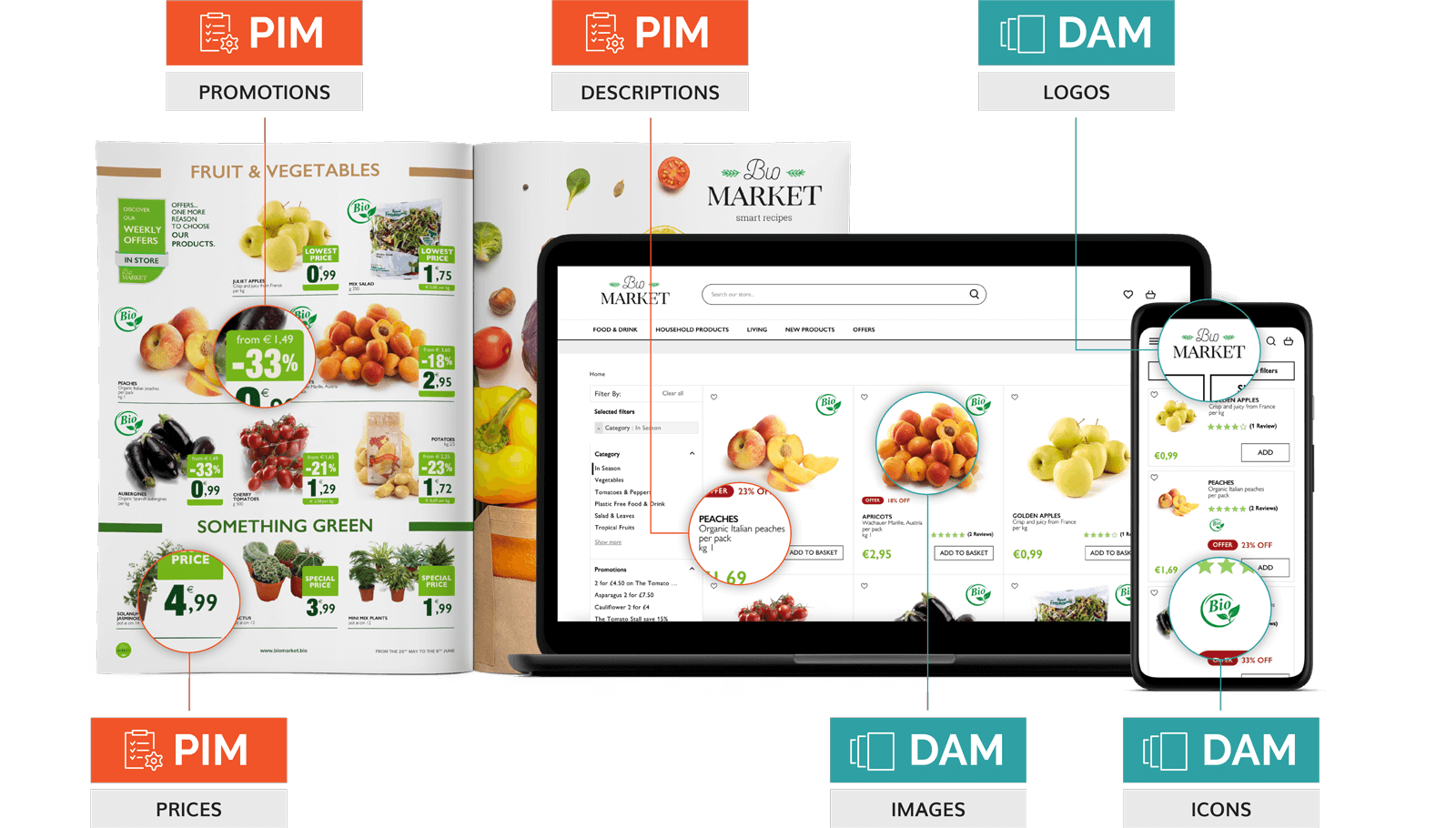
DAM and PIM are both databases that let businesses store, search and serve up information. The main difference is that a PIM usually contains text and data – such as prices, product descriptions, availability – while a DAM contains more visual elements – like images, video, and artwork. Without a PIM – DAM integration, you have a ‘Brain’ that can't speak and a ‘Face’ with no identity. WoodWing Assets ensures that when the Brain (PIM) says ‘This is SKU-123’, the Face (DAM) automatically presents the correct imagery.
Software continually grows more sophisticated, blurring boundaries between PIM and DAM. You can buy PIMs with DAM functionality, DAMs with PIM functionality, and all-in-one software that promises to do everything an e-commerce business needs (and more). Many all-in-one packages, however, deliver a diluted version of both products. The better option by far is to integrate separate PIM and DAM software, to benefit from the full functionality of both. WoodWing recognized the power of integrating a DAM with another software package early on. Its extensive Integration Marketplace – full of smart software to help extend existing software functionalities – speaks volumes in that regard.
Benefits of a PIM and DAM integration
PIM and DAM work hand-in-hand to solve one of the major operational headaches for retailers – how to receive, process, manage, and publish information relating to millions of products. Managing workflows, images, and data for that many products in such a fast-moving, time-sensitive environment is difficult but essential. Because without integrating the two, you're stuck running ineffective processes that reduce productivity, increase time-to-market, and undermine the bottom line.
PIM and DAM can be integrated to:
- Automatically receive and approve product information and assets from different sources.
- ‘Marry’ product imagery and video with up-to-date product descriptions and prices.
- Fully automate web page production and app content.
- Automatically populate catalog templates in InDesign and other programs.
This way, it becomes much easier and more cost-effective to deliver consistent, media-rich experiences across a growing range of channels. A PIM – DAM integration delivers these cost savings and productivity gains by:
- Providing all collaborators with immediate access to approved, up-to-date information and assets from a single source of truth.
- Reducing the time to create online, in-app, and printed content.
- Freeing staff from doing repetitive tasks, and increasing team capacity.
- Encouraging the reuse of assets, increasing their ROI.

How to integrate PIM and DAM
Custom coding a PIM and DAM integration is expensive and prone to errors. Luckily, there are other options. Because WoodWing early on recognized the necessity to integrate its software with other useful software packs that could increase software effectiveness, it developed and populated its WoodWing Integration Marketplace with smart and useful integrations. Without the need to self-develop integrations, the marketplace offers the hugely valuable ‘plug-and-play’ advantage.
Retailers need the flexibility to choose the best PIM for their specific needs; with WoodWing, they can. WoodWing specifically developed WoodWing Connect to enable these integrations and offer maximum flexibility in getting the most out of their software choices. Connect ensures that, while your business grows and your tech stack evolves, your content supply chain never breaks.
From efficiency to velocity
In modern e-commerce, team efficiency is no longer your crucial factor; it's all about velocity now. While integrated tools certainly make staff faster, the true strategic value of content orchestration lies in shrinking time-to-market from weeks to hours. By automating the link between product data and rich media, retailers can almost instantly move a product from the warehouse to a ‘shoppable’ state across every global channel. In retail and e-commerce, this velocity transforms the content supply chain into an impressive competitive weapon.
Reducing content waste and minimizing human error at scale further accelerates your content supply chain. Retailers often bleed revenue simply because high-value assets – expensive lifestyle photography or 3D models – are buried deep in silos, forcing teams to recreate what they already own. WoodWing Assets solves this by using AI to make every asset instantly discoverable, ensuring your best content is actually working for you instead of gathering digital dust. When this DAM ‘face’ is locked to the PIM’s ‘brain’, the risk of costly inaccuracies – like the wrong price or a mismatched photo – is practically eliminated. The result is a seamless, accurate customer experience that not only drives growth but also significantly lowers return rates by ensuring customers get exactly what they see on their screens.
One source of truth, infinite storefronts
In today's retail landscape, the ‘storefront’ is no longer a static destination; it is a fluid ‘ecosystem’ spanning TikTok Shops, mobile apps, Amazon marketplaces, and interactive in-store displays. ‘Orchestrating your content supply chain’ now means moving beyond simply publishing to the web and toward a model of so-called ‘fluid commerce’. By integrating PIM and DAM, you create a headless content feed where a single update to a product's price or sustainability certification in the PIM instantly synchronizes in real-time across every digital touchpoint. This ensures that whether a customer is scrolling Instagram or TikTok, or standing in your flagship store, the brand experience remains perfectly synchronized.

WoodWing Studio is the production engine in this ecosystem, transforming orchestrated data into localized, channel-ready assets at scale. Instead of manual design cycles for every new promotion, Studio pulls the ‘truth’ from the PIM and the ‘asset’ from WoodWing Assets to automatically populate everything from shoppable digital brochures to personalized social posts or carousels. This ‘one source, infinite storefronts’ approach allows retailers to dominate the omnichannel landscape without increasing overhead costs. That way, growth is never limited by your production capacity.
How global retailers orchestrate growth with WoodWing
At WoodWing, we’ve supported retailers around the world to create an integrated software stack that lets them manage their assets and creative processes more strategically. Take a look at several recent customer success stories to understand how retailers use WoodWing software to deliver great customer experiences, increase productivity, and cut costs:
- La Anonima – Argentina’s fourth-biggest supermarket chain – reclaimed control of its content and reinvented its marketing processes using WoodWing Assets.
- Wizard Pharmacy – Western Australian health and wellbeing retailer with thirty-two stores – optimizes print and web marketing production processes.
- S-Group – one of Finland’s widest-reaching retail groups – uses WoodWing Assets to manage millions of e-commerce images with ease.
- Fratelli Carli – A family owned Italian olive oil producer and retailer – managed to offer a consistent customer experience through multichannel (print and digital), 360° communication.
- Hoogvliet – the Dutch grocery giant – saved 40% of their catalog production time with WoodWing Assets and WoodWing Studio.
Orchestrating the future of retail
The era of managing PIM and DAM as isolated silos is gone forever. In a retail environment defined by AI-driven speed and omnichannel complexity, the brands that treat their content as a unified supply chain rather than a collection of files score all the success. By orchestrating product data (the ‘Brain’) with rich media (the ‘Face’), retailers achieve more than just efficiency – they unlock the velocity in their supply chain that they need to capture modern consumer attention.

WoodWing provides the essential infrastructure for this transformation. Through WoodWing Assets, WoodWing Studio, and WoodWing's flexible Integration Marketplace, we empower retailers to bridge the gap between back-end data and front-end experience. The result is a future-proof ecosystem where content flows seamlessly, accuracy is guaranteed at scale, and growth is virtually unlimited.